

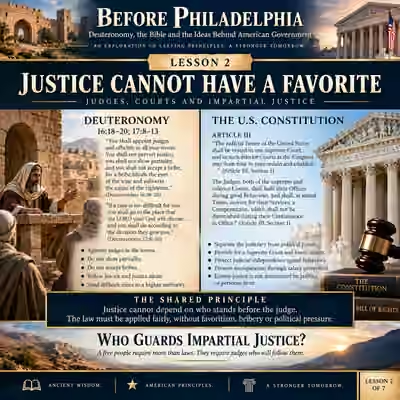
Before Philadelphia · Lesson 2
Justice Cannot Have a Favorite
Judges, Courts and Impartial Justice
In Lesson One, we started with a basic requirement of constitutional government:
The ruler must be under the law.
But that statement creates another problem almost immediately.
Someone still has to interpret the law.
Someone has to hear the dispute.
Someone has to decide which facts are credible, which rule applies and what happens next.
So the next question is just as important as the first:
Who administers justice—and what keeps that person from becoming another kind of ruler?
Deuteronomy has an answer.
And once again, the answer sounds surprisingly familiar.
Start locally
Deuteronomy 16:18 begins by telling Israel to appoint judges and officials throughout its towns.
That matters.
The ordinary dispute was not supposed to require every citizen to travel to one national ruler and ask him personally for justice.
Judicial responsibility was distributed.
Local communities had judges.
Those judges were expected to decide disputes.
But Deuteronomy does not stop by establishing the office.
It immediately establishes the standard.
The judges are commanded to judge fairly. They are told not to distort justice, not to show partiality and not to accept bribes. The reason given for the prohibition on bribery is practical: money distorts the judgment even of people who should know better.
Then comes one of the most memorable statements in the book:
“Follow justice and justice alone.”
That is more than an instruction to have courts.
It is an instruction about what makes a court legitimate.
A courthouse does not create justice merely because a judge sits inside it.
The decision has to be reached justly.
Justice cannot depend on who is standing before the judge
This is where Deuteronomy becomes especially interesting as political thought.
The judge is given authority.
But the judge is immediately prohibited from using that authority according to personal preference.
He cannot distort the standard.
He cannot favor a person because of status.
And he cannot sell a different result to someone willing to pay for it.
That means Deuteronomy recognizes something important about governmental power:
Judicial authority can be corrupted too.
The threat to liberty does not come only from kings.
It can come from the person sitting in judgment.
A legal system therefore needs more than laws.
It needs people administering those laws according to standards that restrain their own discretion.
That distinction matters.
But what happens when the local judge cannot decide?
Deuteronomy anticipates that problem too.
Chapter 17 describes cases involving bloodshed, lawsuits or assaults that prove too difficult for the local court.
The instruction is not:
Guess.
Take a vote.
Let the most powerful person decide.
Instead, the disputed case is taken to a designated central authority involving the Levitical priests and the judge then serving. That authority hears the matter and renders a decision that is binding on the parties.
Some Bible translations actually give this section a heading such as “Appeal to a Higher Court.”
That description is useful, but we should be cautious with it.
This was not an appellate court in the modern American sense.
There was no Article III.
There was no Supreme Court consisting of nine justices.
There was no constitutional separation between church and state comparable to the modern American system.
Priests participated in the central adjudicatory structure precisely because ancient Israel's covenant, religious and civil order were intertwined.
So we should not pretend the institutions are identical.
They aren't.
But look at the structure that is actually present.
There are local decision-makers.
There are disputes those decision-makers may be unable to resolve.
And there is a recognized authority beyond the local level to settle those difficult cases.
That is a judicial hierarchy of a kind, even though it is not the American federal judiciary.
And that distinction lets us make the historical comparison without having to manufacture one.
Now move forward to 1776
Before there was a United States Constitution, individual states were already confronting the problem of judicial power.
Virginia's Declaration of Rights, adopted June 12, 1776, made an important structural choice.
It declared that legislative and executive powers should be “separate and distinct from the judiciary.”
That is something Deuteronomy does not do in the modern American sense.
And this is an important development in our story.
Deuteronomy insists that judges administer justice impartially.
American constitutional thought increasingly asks an additional question:
How do we design the institution so a judge has a better chance of actually doing that?
The answer was separation.
If judges depend too heavily on the political branches, judicial impartiality becomes harder to protect.
So the American system did not merely demand good judges.
It began constructing institutional safeguards around the judging itself.
Massachusetts makes the connection explicit
Four years later, Massachusetts put the principle in unusually direct language.
Article XXIX of the Massachusetts Declaration of Rights says that protecting a person's life, liberty, property and character requires the impartial interpretation of the laws and administration of justice.
It then declares that citizens have a right to judges who are as free, impartial and independent as human circumstances allow.
That sentence deserves some attention.
Free.
Impartial.
Independent.
Those are related concepts, but they are not identical.
A judge must be free enough to decide a case without improper coercion.
A judge must be impartial enough not to decide the case according to favoritism.
And a judge must be independent enough that another branch of government cannot easily punish him simply because it dislikes the decision.
The Massachusetts Constitution then connects those principles to institutional protections, including judicial tenure during good behavior and established compensation.
That begins to look very familiar.
Article III builds the federal judiciary
When the federal Constitution was drafted in 1787, its judicial article was relatively short.
But what it does is significant.
Article III vests federal judicial power in one Supreme Court and whatever inferior federal courts Congress chooses to establish.
It gives those courts jurisdiction over specified categories of cases arising under the Constitution, federal laws and treaties, along with other enumerated controversies.
And then it protects federal judges in two important ways.
They remain in office during good behavior.
And their compensation cannot be diminished while they remain in office.
Why would salary protection belong in the Constitution?
Because independence is difficult when another political institution can threaten your livelihood every time it dislikes your ruling.
The design is structural.
You do not simply tell a judge:
“Be courageous.”
You attempt to build a system in which courage is less likely to cost the judge his office or paycheck.
That is an important development from moral instruction to constitutional architecture.
Hamilton explains why the architecture matters
Alexander Hamilton addressed the judiciary directly in *Federalist No. 78*.
He argued that liberty would be endangered if judicial power were united with legislative or executive authority.
He also argued that permanent tenure was important because courts were otherwise vulnerable to being overpowered, intimidated or influenced by the political branches.
Then Hamilton made the connection to constitutional limits.
If a constitution places limits on legislative power, someone has to be capable of enforcing those limits.
Otherwise the restrictions exist on paper but can disappear whenever the legislature chooses to ignore them.
For Hamilton, independent courts were therefore essential to a limited Constitution.
Notice the progression.
A law limits political authority.
But a limit that nobody can enforce may not remain much of a limit.
So the constitutional system needs judges who can apply law even when powerful people dislike the result.
That is the machinery beneath the phrase rule of law.
The judge has to be restrained too
This is where the comparison with Deuteronomy becomes more useful.
Deuteronomy does not merely create judges and assume justice will follow.
It restrains them.
Do not distort justice.
Do not show partiality.
Do not accept a bribe.
American constitutionalism does not merely create judges and assume justice will follow either.
It attempts to restrain the forces acting upon them.
Separate the judiciary.
Protect judicial tenure.
Protect judicial compensation.
Define jurisdiction.
Create multiple levels of courts.
Allow judges to decide cases according to governing law rather than according to instructions from the executive or legislature.
The methods are different.
But both systems recognize the same underlying problem:
A judge is a human being entrusted with government power.
And power requires boundaries.
There is an important difference
We should stop here long enough to make sure the comparison does not become larger than the evidence.
Deuteronomy does not establish American-style judicial independence.
Its central legal authority includes priests.
Religious law and civil law are not institutionally divided the way they are in the United States.
The king, priests, judges and other authorities exist within Israel's covenant system, not within a modern three-branch republic.
And Deuteronomy does not contain our system of federal and state jurisdiction, lifetime federal judicial tenure, constitutional judicial review or the detailed appellate procedures that developed in American law.
Those differences are substantial.
But historical comparison does not require identity.
The better question is whether the earlier system contains principles that would remain recognizable within the later one.
Here the answer is difficult to ignore.
Local justice.
Impartial judgment.
Condemnation of bribery.
A mechanism for resolving difficult cases beyond the local level.
Binding legal decisions.
And the principle that the person exercising judicial power does not get to substitute favoritism for justice.
Those ideas are plainly present in Deuteronomy.
The American development adds another layer
The American founding takes that problem and asks a structural question:
What conditions make impartial judging more likely?
Virginia separates the judiciary from legislative and executive power.
Massachusetts expressly demands impartial and independent judges.
Article III gives federal judges tenure during good behavior and protects their compensation.
Hamilton explains that this independence is necessary if courts are going to protect a limited Constitution against political encroachment.
That is not copying.
It is institutional development.
And this is precisely why the historical question behind *Before Philadelphia* is more interesting than asking whether one founding document contains Bible verses.
Ideas can survive while institutions change.
A principle can move through centuries of theological, legal and political development before appearing in a form its earliest authors would never have recognized.
The historian's task is to distinguish the principle from the machinery built around it.
What is the principle here?
I think it is this:
Justice cannot have a favorite.
Not the rich.
Not the poor.
Not the politically connected.
Not the popular.
Not the government.
Not the person who can pay the judge.
A legal system becomes something else when the identity of the person before the court determines which version of justice applies.
Deuteronomy understood that.
The American founding generation understood it too.
And the American system tried to turn that moral requirement into institutional design.
That is the connection worth examining.
But impartial judges still need evidence
There is another problem coming.
Even the most impartial judge cannot produce justice from unreliable information.
A judge still has to determine what actually happened.
What if one person makes an accusation?
Is that enough?
What if witnesses disagree?
What obligation exists to investigate the allegation before punishment follows?
And should the government be permitted to take someone's life based upon the testimony of a single person?
Deuteronomy has surprisingly specific answers.
So does the United States Constitution.
And in the next lesson, the comparison becomes much tighter.
Lesson Three: Evidence Before Conviction.
Because before government punishes someone, it should first have to prove its case.
---
Primary texts and further reading
Deuteronomy 16:18–20 and 17:8–13 establish the biblical material for this lesson: local judges, impartiality, the prohibition on bribery and a central process for difficult cases.
The Virginia Declaration of Rights of June 12, 1776, provides an early American statement that legislative and executive powers should be separate from the judiciary.
The Massachusetts Constitution of 1780 is particularly important because Articles XXIX and XXX expressly connect impartial and independent judging with protection of individual rights and separation of governmental powers.
Article III of the United States Constitution establishes the federal judicial branch and protects federal judicial tenure and compensation.
Alexander Hamilton's *Federalist No. 78* provides the founding-era argument for judicial independence under a limited Constitution.