

Before Philadelphia · Lesson 3
Evidence Before Conviction
Witnesses, Investigation and the Difference Between an Accusation and Proof
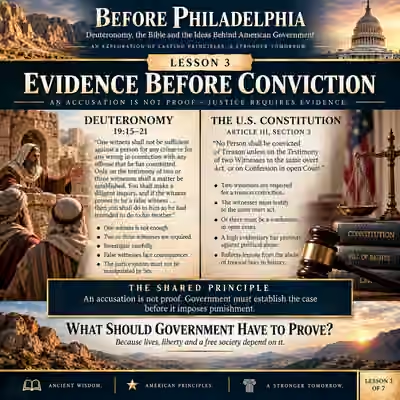
Imagine the government accuses you of the most serious political crime imaginable.
Treason.
The punishment could cost you your freedom, your property or, historically, your life.
Now imagine that the government's entire case depends on one person saying you did it.
Should that be enough?
The writers of the United States Constitution said no.
Thousands of years earlier, Deuteronomy had said something remarkably similar.
That does not prove that the Framers copied Moses.
But this may be one of the clearest places in our *Before Philadelphia* series to see just how old some of the principles we associate with American justice really are.
Because Deuteronomy does not simply tell judges to be fair.
It asks another question.
What should count as proof?
One accusation is not enough
Deuteronomy 19 deals directly with witnesses and criminal accusations.
The rule begins plainly:
One witness is not sufficient to establish someone's guilt. A matter is to be established through the testimony of two or three witnesses.
We should notice what that does.
It places a barrier between an accusation and a judgment.
Someone may make an allegation.
That allegation may even be true.
But the accusation itself does not automatically become sufficient evidence for the government to punish the accused.
There must be corroboration.
That is an evidentiary safeguard.
And Deuteronomy does not stop there.
Investigate the witness too
The next portion may be even more interesting.
Deuteronomy anticipates the possibility that the witness himself may be the problem.
A malicious witness may come forward and accuse someone falsely.
When that happens, the judges are told to make a careful inquiry into the allegation. If the testimony is determined to be false, the dishonest witness faces the consequence he intended to bring upon the accused.
Think about the logic.
Government cannot evaluate only the person being accused.
It must evaluate the accusation.
And sometimes it must evaluate the accuser.
That is an important distinction in any justice system.
A complaint is not a finding.
An accusation is not a conviction.
A witness is not automatically truthful because the witness took the stand.
Evidence has to be tested.
For someone who spent years investigating cases, that principle is difficult to overstate.
The existence of an allegation tells you that an allegation exists.
It does not yet tell you whether the allegation is true.
That requires work.
Deuteronomy understands the danger of false testimony
There is another reason the false-witness provision matters.
A dishonest witness is not merely lying to another person.
The witness is attempting to manipulate the justice system itself.
If the government has the power to imprison, punish or execute, then false testimony can turn public authority into a weapon.
Deuteronomy treats that danger seriously.
This connects directly to the concern from Lesson Two.
A judge must not favor one person over another.
But even an honest judge can reach the wrong result if the evidence presented to that judge is false.
So a functioning justice system requires at least two things:
Impartial decision-makers.
And:
Reliable evidence.
Justice needs both.
Now look at the Constitution
Article III of the United States Constitution contains one of the document's most unusual evidentiary provisions.
The Constitution defines treason narrowly: levying war against the United States or adhering to their enemies by giving them aid and comfort.
Then it restricts how the government may prove the offense.
No person may be convicted of treason unless there is a confession in open court or the testimony of two witnesses to the same overt act.
Pause there.
The Constitution normally does not tell prosecutors how many witnesses they must produce.
There is no constitutional rule requiring two eyewitnesses before someone can be convicted of robbery.
Or murder.
Or fraud.
Or most other federal crimes.
Treason is different.
For one of the most politically dangerous charges government can bring, the Framers placed the evidentiary requirement directly into the Constitution.
Not merely a statute.
Not a courtroom rule Congress could casually rewrite.
The Constitution itself.
Why?
The history of treason helps explain it.
Treason had been abused
The Framers knew English history.
And English treason law provided plenty of reasons to be cautious.
Congress's *Constitution Annotated* explains that the Treason Clause grew from the Framers' awareness of the ways English treason law had expanded and been abused. They wanted a restrictive definition that would prevent those in power from turning ordinary political conflict into charges of treason.
That problem should sound familiar even today.
Political opponents frequently accuse one another rhetorically of betraying the country.
But rhetorical treason and constitutional treason are not the same thing.
The Constitution intentionally makes the legal offense difficult to expand.
That is not an accident.
The Framers had seen what could happen when governments were permitted to define political opposition as betrayal.
So they narrowed both the offense and the proof required to establish it.
There is an English bridge
This is where we have to be especially careful with the historical claim.
The two-witness rule in Article III did not suddenly leap directly from Deuteronomy into the Constitution.
There is an important legal bridge between them.
English law had developed special evidentiary safeguards for treason, including a two-witness requirement. The British Treason Trials Act of 1695 is an important antecedent to the constitutional requirement that treason be proved through two witnesses to the same overt act.
So if someone asks:
“Did the Framers get Article III's two-witness rule directly from Deuteronomy?”
The historically responsible answer is:
We cannot establish that as a simple direct borrowing.
The immediate legal history runs substantially through English treason law.
But that does not make Deuteronomy irrelevant.
It makes the history more interesting.
Biblical evidentiary principles had existed for centuries before the English legal tradition that the Founders inherited.
The task is not to force a straight line where history gives us a network of influences.
It is to recognize that the underlying idea is much older than 1787.
Then the Constitutional Convention gives us something extraordinary
On August 20, 1787, the Constitutional Convention debated the treason provision.
John Dickinson raised a precise question.
If the Constitution required two witnesses, did the two witnesses have to testify about the same overt act, or could each testify about separate acts?
That distinction mattered.
The Convention then considered adding the words requiring both witnesses to testify to the same overt act.
Benjamin Franklin favored the stronger requirement.
According to Madison's notes, Franklin's concern was that treason prosecutions were often especially bitter and that perjury could easily be used against innocent people.
That is a revealing moment.
Franklin was not arguing that treason should go unpunished.
He was recognizing something else.
The more politically charged the accusation, the greater the danger that the justice process itself can become political.
That is precisely when evidentiary safeguards become important.
The provision was adopted.
And it remains in Article III today.
Compare the two rules carefully
Now put the texts beside one another.
Deuteronomy 19
A single witness cannot establish guilt.
Two or three witnesses are required.
False testimony is investigated.
A malicious witness faces serious consequences.
Article III
A treason conviction requires two witnesses.
Those witnesses must testify to the same overt act.
Alternatively, there must be a confession in open court.
The constitutional provision is narrower.
Deuteronomy states its two-or-three-witness requirement broadly for wrongdoing.
The Constitution applies its special two-witness requirement specifically to treason.
So these are not identical criminal codes.
But the underlying concern is unmistakably related:
Government should require more than an unsupported accusation before imposing its most serious punishments.
America develops the principle further
The original Constitution's treason rule is not the end of the story.
The Bill of Rights adds a wider structure of protection around criminal prosecution.
The Fifth Amendment says government may not deprive a person of life, liberty or property without due process of law. It also protects against compelled self-incrimination and double jeopardy and requires a grand-jury indictment for serious federal crimes, subject to specified exceptions.
The Sixth Amendment adds more.
A criminal defendant is entitled to a speedy and public trial.
An impartial jury.
Notice of the accusation.
Confrontation with the witnesses against him.
The ability to obtain witnesses in his favor.
And assistance of counsel.
Again, none of this means those amendments were simply copied from Deuteronomy.
Their immediate history includes centuries of English common law, colonial practice, state declarations of rights and reaction against abuses of criminal procedure.
But look at the direction in which the system is moving.
Government cannot merely accuse and punish.
Government has to proceed through a process.
The charge must be identified.
Evidence must be presented.
Witnesses can be challenged.
The accused may produce evidence too.
An independent decision-maker must determine whether the government has met its burden.
That is a constitutional justice system.
The accused is not required to prove his innocence
There is a deeper principle underneath these safeguards.
When government accuses someone of a crime, the burden does not begin with:
“Prove you didn't do it.”
The burden begins with government establishing its case.
Our modern constitutional doctrine surrounding criminal procedure has developed far beyond anything contained in Deuteronomy.
But the instinct visible in Deuteronomy 19 is recognizable.
Do not move from allegation to punishment without sufficient proof.
That space between the two matters.
In that space lives investigation.
Cross-examination.
Corroboration.
Contradictory evidence.
Credibility.
Reasonable doubt.
And sometimes acquittal.
A justice system should be able to say:
We accused the wrong person.
That is not necessarily evidence that justice failed.
Sometimes that is evidence that the safeguards worked.
There is another side to this
Safeguards for the accused have a cost.
Making conviction more difficult can mean that guilty people escape punishment.
The Framers understood this problem too.
During the Convention's treason debate, James Wilson observed that treason could sometimes be conducted in ways that made proof extremely difficult.
That is the tradeoff.
Lower the evidentiary barrier too far and innocent people become easier to punish.
Raise it too far and guilty people become harder to convict.
Every justice system has to decide where that risk should fall.
The American constitutional tradition generally accepts that government should carry substantial burdens before taking liberty—and especially life—from an accused person.
That preference is not weakness.
It reflects an understanding of what governmental error can cost.
Aaron Burr eventually tested the rule
The Treason Clause was not left as a theoretical protection.
In 1807, former Vice President Aaron Burr was prosecuted for treason.
Chief Justice John Marshall's handling of the case placed substantial weight on Article III's evidentiary requirements. Because Burr had not been present at the alleged assemblage used to support the treason charge, the government faced difficulty producing the constitutionally required evidence connecting him to the overt act.
Burr was ultimately acquitted.
Whatever someone thinks of Burr himself, the constitutional lesson is important.
The seriousness of an accusation does not reduce the government's burden.
It increases the importance of following the rule.
The government accused a former vice president of treason.
The court still had to ask:
Where is the constitutionally sufficient evidence?
That is rule of law in practice.
The safeguard survived into the modern era
The two-witness requirement has continued to matter in American treason cases.
During the twentieth century, the Supreme Court considered how strictly Article III's requirement should apply.
In *Cramer v. United States*, the Court emphasized that the Constitution's two-witness protection prevents the government from simply imputing the necessary overt acts through a single witness or circumstantial inference. Later cases refined how the requirement interacts with proof of intent.
The details of modern treason doctrine are complicated.
But the important point for this lesson is simpler.
More than two centuries after Philadelphia, prosecutors still cannot erase the evidentiary restriction the Framers put into Article III.
The government remains bound by it.
Now return to Deuteronomy
This is where the comparison becomes useful.
Deuteronomy 19 recognizes at least four problems that any functioning justice system has to confront:
People can make false accusations.
A single witness can be wrong or dishonest.
Judges need to investigate rather than simply accept claims.
False testimony can weaponize government against the innocent.
Those are not uniquely ancient problems.
They are human problems.
Technology changes.
Courtrooms change.
Legal procedure changes.
Human beings do not change nearly as much.
We still lie.
We still misunderstand what we see.
We still hold grudges.
We still make mistakes.
We still become certain before the evidence justifies certainty.
And political accusations can make all of those weaknesses worse.
That is why evidentiary rules exist.
So did the Constitution copy Deuteronomy?
No responsible history requires us to make that claim.
The American Treason Clause has identifiable English legal antecedents.
The Framers explicitly discussed the dangers of English treason prosecutions.
The Convention itself debated the evidentiary language.
Those facts belong in the story.
But Deuteronomy belongs in the story too.
Long before the English Treason Trials Act.
Long before Blackstone.
Long before Franklin, Madison or Wilson.
Long before Philadelphia.
The biblical law had already articulated a principle that sounds familiar:
An accusation requires corroboration before government may treat it as established guilt.
And when a witness is suspected of lying?
Investigate.
That is not a modern idea.
The principle beneath both systems
This lesson is not really about the number two.
It is about the separation between claim and proof.
Someone says something happened.
That is a claim.
A witness says someone committed a crime.
That is testimony.
Evidence supports or undermines the testimony.
Investigation tests it.
A legal process determines whether the government has proved the accusation sufficiently to justify punishment.
Those categories should never be collapsed into one another.
Because once accusation becomes synonymous with guilt, the justice system no longer needs evidence.
It only needs accusers.
Deuteronomy does not permit that.
Neither does the American constitutional tradition.
Different rules.
Different courts.
Different historical settings.
But once again, an old governmental problem produces a recognizable principle.
Evidence before conviction.
One more question remains
Suppose the evidence is sufficient.
Suppose the person really is guilty.
Who should suffer the consequences?
Only the offender?
Or can government punish the offender's family too?
Can a father's crime attach to his children?
Can the legal consequences of treason pass through a bloodline?
Deuteronomy has an answer.
And Article III contains a provision that makes the next comparison almost as remarkable as this one.
Lesson Four: Guilt Is Personal
Because constitutional government has to decide not only whether someone is guilty.
It also has to decide who may justly be punished for that guilt.
---
Primary texts and further reading
Deuteronomy 19:15–21 establishes the two-or-three-witness requirement, directs judges to investigate false testimony and prescribes consequences for malicious witnesses.
Article III, Section 3 of the United States Constitution narrowly defines treason and requires two witnesses to the same overt act or confession in open court for conviction.
The Congressional Research Service's Constitution Annotated explains the Framers' concern over historical abuse of English treason law and the constitutional decision to make both the offense and its proof difficult to expand politically.
Madison's notes from August 20, 1787 record the Convention's debate over requiring two witnesses to the same overt act, including Benjamin Franklin's concern about perjury in politically charged treason prosecutions.
The Fifth and Sixth Amendments provide the broader American framework of due process, jury trial, confrontation, defense witnesses and counsel in criminal prosecutions.
The Aaron Burr treason proceedings provide an early example of Article III's evidentiary restrictions operating against the federal government's prosecution of a politically prominent defendant.