

Before Philadelphia · Lesson 1
The Ruler Is Under the Law
Power exists to serve the people — and the law.
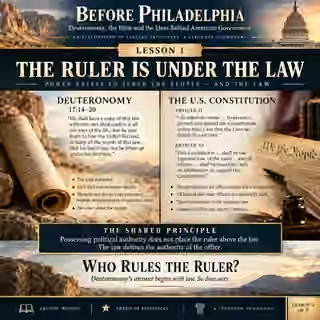
There is a simple question at the heart of constitutional government:
Who is above the law?
The American answer is supposed to be no one.
Not the police officer.
Not the judge.
Not the member of Congress.
Not the president.
Government officials receive authority from law, exercise authority within law and can be held accountable when they exceed the authority law gives them.
We have a familiar phrase for this:
The rule of law.
But Americans did not invent the idea in 1787.
Long before Philadelphia, Deuteronomy confronted essentially the same problem.
And it did so by addressing the most powerful person in government.
The king.
A strange kind of king
Deuteronomy 17:14–20 anticipates the day when Israel will demand a king “like all the nations” around it.
What follows is remarkable.
The passage does not spend most of its time describing what the king can do.
It describes what he cannot do.
He cannot multiply horses for himself.
He cannot accumulate wives in a way that turns his heart away.
He cannot greatly accumulate silver and gold.
Then comes something even more important.
Once on the throne, the king is to have a copy of the law, keep it with him and read it throughout his life.
Why?
So that he learns to obey it and so that, in the language of the passage, his heart is not “lifted up above his brothers.” (Bible Gateway)
Think about the political idea contained in that.
The king has power.
But power does not make him the law.
The law exists before him.
It applies to him.
And holding office does not make him a different class of human being from the people he governs.
That is a profound limitation on political authority.
The ruler is not the source of law
This distinction is easy to miss because monarchy normally makes us think of concentrated power.
A king sits at the top.
Orders move downward.
But Deuteronomy’s model complicates that picture.
The king does not receive authority to rewrite the governing law according to his preference.
He is commanded to know it.
He is commanded to follow it.
And he is specifically warned against the things rulers throughout history have often pursued: military power, wealth, personal excess and elevation above the people.
Biblical scholar Bernard Levinson has gone so far as to describe the governmental material in Deuteronomy 16:18–18:22 in constitutional terms. His argument is that two ideas appearing there are foundational to constitutional government: political authority is divided among different institutions, and those institutions are themselves subordinate to law. (SSRN)
Another scholarly treatment in the International Journal of Constitutional Law makes the same point more cautiously: Deuteronomy deserves attention in the history of political thought because it anticipates both the division of governmental authority and the rule of law over political actors. (OUP Academic)
That does not make ancient Israel a modern constitutional republic.
It was not.
But we should be just as careful about making the opposite error.
The fact that Deuteronomy is ancient does not mean its political ideas are primitive.
Look at what is being restrained
The restrictions themselves tell us something about how Deuteronomy understands political power.
Horses were not merely transportation. In the ancient world, horses and chariots represented military capability and royal power.
Silver and gold represented economic accumulation.
Multiple wives, particularly in royal settings, could also be tied to dynastic and international relationships.
Then there is pride: the king must not elevate himself above his countrymen.
Put those together and the concern becomes clearer.
Military power.
Wealth.
Political relationships.
Personal status.
Deuteronomy recognizes that political office can become a mechanism for accumulation.
So it places boundaries around the person who occupies it.
The important point is not that an American president is equivalent to an Israelite king.
He isn’t.
The important point is the governing principle:
Possessing political authority does not eliminate the need for restraint. It creates the need for it.
This idea did not disappear
There is another historical step worth understanding before we jump from Moses to Madison.
Biblical ideas about constrained kingship continued to circulate through Western political thought.
One particularly interesting example involves Archbishop Stephen Langton, one of the central church figures associated with the political struggle that produced Magna Carta in 1215.
A Cambridge University Press volume examining religion and the rule of law notes Langton’s extensive engagement with the Old Testament and Deuteronomy. The scholarship describes his understanding of biblical kingship as one in which written law prevented the king from simply claiming more authority than had been established. (Cambridge University Press)
That does not mean Magna Carta is simply Deuteronomy rewritten in Latin.
History rarely works that neatly.
But it demonstrates why tracing political ideas requires more than asking whether the American Founders directly quoted a particular verse.
Ideas move through institutions.
They move through churches, universities, legal traditions, political conflicts, books, sermons and earlier constitutional documents.
By the time Americans began constructing governments of their own, the argument that rulers themselves were bound by law had a very long history.
Then John Adams makes the principle explicit
Jump forward to Massachusetts.
In 1779, a committee associated closely with John Adams produced a proposed constitution for the Commonwealth of Massachusetts.
The resulting Massachusetts Constitution, ratified in 1780, contains one of the clearest statements of the idea we are examining.
Its separation-of-powers provision ends by explaining the purpose:
“a government of laws and not of men.” (Massachusetts General Court)
That sentence deserves attention.
A government of men means the answer ultimately depends upon who holds power.
A government of laws means the officeholder operates inside a framework that does not disappear when it becomes inconvenient.
Adams had expressed the same idea in Thoughts on Government in 1776, arguing that the best republican government would be structured to secure the impartial execution of the laws and to keep governmental powers distinct. (Founders Online)
The Massachusetts Constitution matters to our story for another reason.
The Founders Online editorial history describes it as an important development in America’s constitutional tradition and notes that its system of checks and balances, a strong executive and an independent judiciary helped prepare the way for the federal Constitution adopted several years later. (Founders Online)
Now we are getting closer to Philadelphia.
What does the United States Constitution do with the president?
The United States did not create a king.
That was rather the point.
But the new republic still needed an executive capable of exercising substantial power.
So what would restrain him?
Start with something Americans hear every four years but may not stop to consider.
Before exercising presidential power, Article II requires the president to swear or affirm that he will faithfully execute the office and “preserve, protect and defend the Constitution.” (National Archives)
Notice the relationship.
The president does not swear to defend his own authority.
The Constitution defines his authority, and he swears to defend the Constitution.
Article II also commands that the president “take Care that the Laws be faithfully executed.” (National Archives)
Then Article VI goes further.
Members of Congress, state legislators, and executive and judicial officers at both the federal and state level are bound by oath or affirmation to support the Constitution. The Constitution, federal laws enacted pursuant to it and treaties made under federal authority constitute the “supreme Law of the Land.” (National Archives)
And if the president or other civil officers commit treason, bribery or other high crimes and misdemeanors, the Constitution provides for impeachment and removal. (National Archives)
The office is powerful.
The officeholder is not sovereign.
Deuteronomy and the Constitution are not saying the same thing
This is where historical discipline matters.
Deuteronomy is covenant law for ancient Israel.
The Constitution establishes a federal republic.
Deuteronomy grounds political authority ultimately in God and covenant.
The federal Constitution begins with “We the People” and creates governmental authority through a written civil framework.
Deuteronomy’s king is a monarch.
The American president is an elected executive with a fixed term, enumerated powers and institutional checks.
Those differences are real.
So I am not claiming that Article II is a rewritten Deuteronomy 17.
We do not need that claim.
The comparison is significant without it.
Both political systems confront the same fundamental danger:
What happens when the person entrusted with power begins to believe that possessing power places him above its limits?
Deuteronomy’s answer is that the king must live under law.
The American constitutional answer is that the president occupies an office created, defined and constrained by a superior written charter.
Different governments.
A recognizable governing principle.
Madison identifies the problem
The Framers were not naive about human beings in government.
Federalist No. 51 makes that unmistakable.
Madison’s argument was not that good government could simply depend on finding unusually good people.
The structure itself had to account for human nature.
Government had to be given enough authority to govern, but it also had to be made to control itself. That is why constitutional powers were separated and why different institutions were given means of checking one another. (Research Guides)
Deuteronomy approaches the problem differently, but notice the shared assumption.
Do not build political institutions on the expectation that possession of power will make people less susceptible to human weakness.
Deuteronomy warns its king about wealth, military strength, relationships, pride and disobedience.
Madison warns that ambition must be accounted for structurally.
Neither system begins with the assumption that a ruler can simply be trusted because he is the ruler.
That is worth sitting with.
What, then, is the actual connection?
There are at least three different claims we could make, and they should not be confused.
Claim One: Deuteronomy contains an early rule-of-law principle.
That is strongly supported by the text itself. The king is explicitly placed under an existing body of law.
Claim Two: Biblical ideas of bounded kingship became part of the Western political tradition.
There is historical evidence for that as well, including the medieval use of Deuteronomy in debates over royal authority and later Christian political thought.
Claim Three: The American Constitution’s limits on executive power were directly copied from Deuteronomy.
That is much harder to establish, and I would not make that claim.
American constitutionalism has multiple tributaries: English law, colonial experience, state constitutions, Enlightenment political philosophy, classical republican thought, Protestant political theology and biblical ideas among them.
History usually gives us a river, not a single pipe.
The question is whether Deuteronomy belongs somewhere upstream.
On this issue, I think the evidence says that it does.
The principle beneath both systems
Strip away the titles for a moment.
King.
President.
Governor.
Judge.
Legislator.
The title changes.
The underlying problem does not.
Every government must eventually answer this question:
Does holding office give a person authority over the law, or does the law define the authority of the office?
Deuteronomy 17 gives a remarkably early answer.
The ruler must know the law.
The ruler must obey the law.
The ruler must restrain his accumulation of power.
And the ruler must remember that sitting above the people institutionally does not make him superior to them as a person.
Thousands of years later, American constitutionalism would express the principle in its own vocabulary.
The president swears to preserve the Constitution.
Public officers swear to support it.
Governmental power is divided.
Abuses of office can lead to removal.
And an earlier American constitution captured the idea in six words:
A government of laws, not men.
The systems are not identical.
Their theological and political foundations are not identical.
Their institutions are not identical.
But the question they are answering should sound very familiar.
Who rules the ruler?
Deuteronomy’s answer begins with law.
So does ours.
What to watch for in Lesson Two
Putting the ruler under law raises an immediate problem:
Who decides what the law requires when people disagree?
Deuteronomy does not leave that unanswered.
It establishes judges, commands impartiality and creates a process for difficult cases that cannot be settled locally.
That takes us to the next part of Before Philadelphia:
Lesson Two: Judges, Courts and Impartial Justice
Because limiting the ruler is only part of constitutional government.
Someone still has to administer the law.
And Deuteronomy has quite a bit to say about how that should be done.
Sources and further reading
Primary texts and research used or referenced in this lesson.
Primary biblical text for the law of the king.
Primary text for Articles II and VI, the presidential oath, the Take Care Clause, supremacy and impeachment provisions.
Official Massachusetts text, including Article XXX and the phrase ‘a government of laws and not of men.’
Primary-source text on republican government, impartial execution of law and separated powers.
Primary text on checks, balances and structuring government to account for human nature.
Scholarship examining Deuteronomy 16:18–18:22 in relation to rule of law and divided political authority.
International Journal of Constitutional Law scholarship discussing Deuteronomy and constitutional government.
Discussion of Stephen Langton, Deuteronomy and bounded kingship in the context of Magna Carta.