

Before Philadelphia · Lesson 5
Punishment Has Limits
Proportionality, Human Dignity and the Power of the State
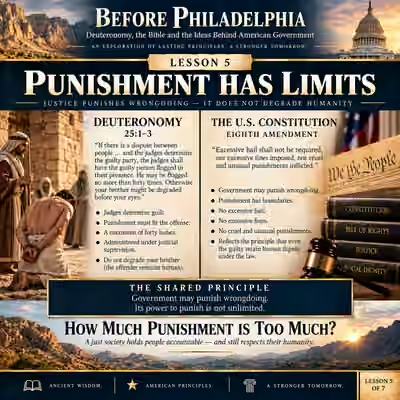
Imagine there is no question about guilt.
The investigation was proper.
The evidence was sufficient.
The judge was impartial.
The defendant committed the crime.
Government therefore possesses legitimate authority to punish him.
Does that settle the matter?
Not quite.
There is another question constitutional government eventually has to answer:
Once government has the right to punish, how far does that right extend?
Can it impose any punishment it chooses?
Can punishment become deliberately degrading?
Can the state impose a penalty wildly out of proportion to the offense simply because the defendant really is guilty?
Deuteronomy confronts that problem directly.
And the way it does so reveals something important about biblical justice.
Accountability matters.
So do limits.
The court first determines guilt
Deuteronomy 25 begins where our previous lessons have taken us.
There is a dispute.
The parties appear before judges.
The judges determine who is innocent and who is guilty.
Then the passage addresses a particular form of punishment.
If the guilty person deserves a beating, the judge supervises it and the number of lashes is tied to what the offense warrants.
Already there is a structure.
First comes adjudication.
Then guilt.
Then punishment.
The punishment is not simply whatever the person administering it feels like inflicting.
It is connected to the offense.
That is proportionality in a basic form.
Then Deuteronomy establishes a ceiling
The next instruction is even more striking.
Forty lashes may be imposed.
But no more.
The law establishes a maximum punishment even though the defendant has been properly convicted.
That tells us something about governmental authority.
The fact that government may legitimately punish does not mean government possesses unlimited punitive power.
There is a line.
Before the punishment begins, the defendant has committed an offense.
After the fortieth lash, he has still committed the offense.
Nothing about his guilt has changed.
What changes is the government's authority.
It has reached the boundary.
That is an important distinction.
Why forty?
The most revealing part of the passage may not be the number.
It may be the reason.
Deuteronomy warns that exceeding the maximum would degrade the offender before the community.
Notice what the law does not say.
It does not say:
He committed the crime, so what happens to him no longer matters.
It does not say:
Guilty people surrender every claim to human dignity.
It does not say:
If forty lashes are justified, eighty must be twice as just.
Instead, the law distinguishes punishment from degradation.
The offender remains accountable.
But he also remains human.
That tension is at the heart of this lesson.
Accountability is not permission for cruelty
There is sometimes an assumption that concern about punishment means concern about offenders instead of victims.
That is too simple.
A justice system can hold someone fully accountable while still restricting what government may do to that person.
Those ideas are not opposites.
In fact, limiting punishment can make justice more precise.
If ten units of punishment are deserved and government imposes one hundred, the extra ninety do not create more accountability.
They create excess.
Deuteronomy's punishment rule recognizes that distinction.
The number is connected to the offense.
Then there is a ceiling.
And the reason for that ceiling explicitly concerns degradation.
There is another biblical principle nearby
Deuteronomy 19 contains the familiar formulation sometimes summarized as “life for life, eye for eye, tooth for tooth.”
That language is sometimes read as evidence of unusual biblical harshness.
But legally, the principle also performs a limiting function.
Punishment is not supposed to escalate endlessly beyond the wrong committed.
The response is bounded by the offense.
A lost eye does not authorize exterminating someone's family.
A tooth does not justify killing the offender.
The principle restricts retaliation as well as authorizes punishment.
So within Deuteronomy, justice repeatedly carries two ideas at once:
Wrongdoing deserves consequences.
And:
Consequences have boundaries.
Jump forward to England
Now we need to make an important historical distinction.
The wording of the American Eighth Amendment did not originate in Deuteronomy 25.
There is a much more immediate documentary history.
The English Bill of Rights of 1689 declared that excessive bail should not be required, excessive fines should not be imposed, and cruel and unusual punishments should not be inflicted.
The provision emerged from English political and legal struggles over abuses of royal power.
The Constitution Annotated history of the Eighth Amendment notes that the English experience behind the clause included concern about arbitrary and disproportionate punishment.
This is important for our investigation.
If we are asking where the language of the Eighth Amendment came from, England provides the immediate answer.
If we are asking how old the principle that governmental punishment must have limits is, the story goes much farther back.
Those are different historical questions.
We should not confuse them.
Virginia carries the language into America
In June 1776, before the Declaration of Independence had even been adopted, Virginia approved its Declaration of Rights.
George Mason's document contained this provision:
Excessive bail should not be required.
Excessive fines should not be imposed.
Cruel and unusual punishments should not be inflicted.
Sound familiar?
It should.
The language substantially tracks the English protection.
And the Library of Congress identifies the Virginia Declaration of Rights as an important model for the amendments that later became the federal Bill of Rights.
This gives us a reasonably clear documentary path:
English Bill of Rights — 1689
↓
Virginia Declaration of Rights — 1776
↓
United States Bill of Rights — 1791
That is the immediate legal genealogy.
We do not need to erase it to recognize that the underlying problem is much older.
Then comes the Eighth Amendment
The federal Constitution originally ratified in 1788 did not contain the Bill of Rights as we know it today.
Those protections were added through the first amendments and ratified in 1791.
The Eighth Amendment reads:
“Excessive bail shall not be required, nor excessive fines imposed, nor cruel and unusual punishments inflicted.”
Look at the repeated idea contained in that sentence.
Excessive.
Excessive.
Cruel and unusual.
Government may require bail under appropriate circumstances.
But not excessive bail.
Government may impose fines.
But not excessive fines.
Government may punish someone convicted of a crime.
But there are punishments government may not inflict.
Again, the constitutional principle is not:
Government cannot punish.
It is:
Government's power to punish has boundaries.
That distinction matters
Limited government is sometimes discussed as though it simply means smaller government.
That misses something.
The constitutional question is often not whether government possesses a legitimate power.
The question is what happens after we concede that it does.
Government can investigate crime.
But there are limits.
Government can prosecute crime.
But there are limits.
Government can convict.
But there are evidentiary requirements.
Government can punish the guilty.
But there are limits there too.
The boundary is part of the authority.
Not an exception to it.
The Founders were arguing about proportionality too
The historical record also shows that Americans were thinking about punishment in terms broader than simply banning medieval torture.
The Constitution Annotated notes that the history behind the Cruel and Unusual Punishments Clause included concern with arbitrary and disproportionate punishment.
James Iredell, writing during the ratification debate in 1788, spoke of punishment being proportioned to both the offender and the offense—a formulation later discussed in the constitutional history of the Eighth Amendment.
That word matters:
Proportioned.
Punishment is not evaluated solely by asking whether the defendant deserves something.
It also asks whether the particular punishment bears an appropriate relationship to the wrong.
Deuteronomy 25 had framed its punishment in comparable terms: the number of lashes was connected to what the crime warranted.
Again, that does not establish direct borrowing.
It establishes a recognizable principle appearing in two legal traditions separated by centuries.
Even the Eighth Amendment was debated
When Congress considered the proposed protection in 1789, not everyone thought the language was sufficiently clear.
The historical record preserved by Congress notes objections that “cruel and unusual” was indefinite and might interfere with punishments legislators considered necessary.
That debate is useful because it demonstrates that constitutional limits are rarely self-defining.
Everyone may agree that government should not be cruel.
The disagreement begins when we ask:
What qualifies as cruel?
What qualifies as excessive?
How disproportionate does a punishment have to become before it crosses the constitutional line?
Those questions did not disappear in 1791.
Courts are still answering them.
The modern constitutional doctrine is more complicated
It would be too broad to tell readers that the Eighth Amendment simply requires every American criminal sentence to be perfectly proportional.
That is not an accurate description of modern constitutional law.
The Supreme Court has recognized a proportionality principle under the Eighth Amendment, including the proposition that punishment can become constitutionally impermissible when grossly disproportionate to an offense. But the doctrine, particularly for prison sentences outside the death-penalty context, has developed with significant limitations.
That qualification matters.
Our purpose here is not to pretend Deuteronomy 25 contains modern Eighth Amendment jurisprudence.
It plainly does not.
Our question is older and more basic.
Should government possess unlimited punitive authority over someone merely because that person is guilty?
Both traditions answer no.
Excessive fines reveal the principle especially well
The Eighth Amendment does not deal only with physical punishment.
It also prohibits excessive fines.
That expands the idea.
Government could impose a legitimate financial penalty.
But legitimacy of purpose does not automatically establish legitimacy of amount.
A $100 fine and a $100 million fine are not interchangeable simply because both are labeled punishment.
At some point, amount matters.
The Supreme Court has recognized that the Excessive Fines Clause protects against abuse of government's punitive authority.
That gives us another way to understand the principle.
The question is not merely:
May government punish?
It is:
How much?
By what method?
For what offense?
And where is the boundary?
Those are constitutional questions.
Deuteronomy's answer preserves something beyond the sentence
Return now to the end of Deuteronomy 25:3.
The offender has been judged.
The offender has been condemned.
The offender has been punished.
And yet the law still describes him as a member of the community whose degradation matters.
That may be the deepest principle in the passage.
Criminal wrongdoing changes a person's legal status.
It can justly change his liberty.
It can justly cost him money.
In ancient Israel, it could subject him to corporal punishment.
But guilt does not make the offender less than human.
Government therefore cannot justify every act of cruelty simply by pointing backward and saying:
But he was guilty.
Guilt establishes authority to punish.
It does not establish infinity.
Justice and vengeance are not the same thing
This is where punishment becomes morally difficult.
Victims deserve justice.
Communities need protection.
Wrongdoing requires accountability.
Some offenders require confinement.
Some crimes warrant severe penalties.
Nothing in Deuteronomy 25 denies any of that.
The passage assumes punishment is legitimate.
But justice is not measured simply by how much suffering government can produce.
There is a point at which punishment can stop serving justice and begin serving degradation, revenge, spectacle or cruelty.
A constitutional system has to recognize that possibility because government is made up of people.
And people can become excessive when they are angry.
We can become excessive when we are afraid.
We can become excessive when the person being punished is unpopular enough that nobody feels compelled to defend the boundary.
That is precisely when the boundary matters.
Rights matter most when we dislike the person using them
There is an uncomfortable truth underneath almost every protection we have examined in this series.
The person benefiting from the protection may actually be guilty.
The ruler we restrain may be popular.
The defendant demanding evidence may be someone we believe committed the crime.
The convicted person protected from excessive punishment may have done something terrible.
Constitutional restraints do not exist only for sympathetic people.
If they did, they would not be restraints.
A limitation on government is tested when respecting it becomes inconvenient.
Deuteronomy places its punishment ceiling on the treatment of a guilty person.
The Eighth Amendment protects people against governmental punishment after the government has acquired authority to punish them.
That is precisely why these protections matter.
So did the Eighth Amendment come from Deuteronomy?
Not directly in any way we can responsibly establish.
The documentary path of the Eighth Amendment's language is unusually clear.
The English Bill of Rights contained the predecessor language.
Virginia repeated it in its 1776 Declaration of Rights.
The federal Bill of Rights ultimately constitutionalized it.
That is the historical record.
But *Before Philadelphia* is asking a second question too:
Were the governmental principles Americans eventually constitutionalized themselves entirely new?
Here, once again, the answer becomes more complicated.
Deuteronomy 25 had already created a punishment scheme in which:
A judge determines guilt.
The punishment corresponds to the offense.
Government faces a numerical maximum.
And the offender's human dignity establishes a reason not to exceed it.
That is not the Eighth Amendment.
But it is recognizably a limitation on the punitive power of government.
And it predates the American Republic by millennia.
The pattern is becoming difficult to miss
We are five lessons into this series now.
Look at what we have encountered.
The ruler is under law.
Judges must administer justice impartially.
Accusation is not proof.
Guilt belongs to the offender rather than the bloodline.
And now:
Even lawful punishment has limits.
These are not small ideas.
Together they describe something approaching a theory of restrained political authority.
Government exists.
Government acts.
Government judges.
Government punishes.
But at each point, a boundary appears.
That is the larger pattern worth seeing.
The principle beneath both systems
Deuteronomy's forty-lash maximum is not America's Eighth Amendment.
Ancient Israel's corporal punishment is not modern American sentencing.
And the constitutional phrase “cruel and unusual” came through a specific English and colonial legal history.
Those differences belong in an honest account.
But beneath them is a principle that both systems recognize:
# The power to punish is not the power to punish without limit.
A guilty person can deserve punishment and still possess human dignity.
A legitimate penalty can become excessive.
And government does not become just merely because the person suffering at its hands has done something wrong.
That may be one of the hardest limits on government to defend.
It is also one of the most important.
Next: what if government has a legitimate claim against you?
The next lesson moves out of the courtroom and to the front door.
Deuteronomy describes a creditor who is genuinely owed a debt.
The creditor has a legitimate claim.
But the law still tells him something remarkable:
Do not enter the debtor's house to seize the pledge. Stand outside.
Centuries later, the American constitutional tradition would place extraordinary importance on the boundary surrounding the home.
That comparison requires careful handling.
But it raises the next question in *Before Philadelphia*:
Lesson Six: Authority Stops at the Door
Because having a legitimate governmental—or legal—purpose does not automatically give someone unlimited authority over your home.
---
Primary texts and further reading
Deuteronomy 25:1–3 establishes the central biblical rule: punishment follows judicial judgment, the amount is connected to the offense, corporal punishment is capped at forty lashes, and exceeding that limit is prohibited because of the degradation it would impose on the offender.
The English Bill of Rights of 1689 prohibited excessive bail, excessive fines, and cruel and unusual punishments and became an important model for later American protections.
Section 9 of the Virginia Declaration of Rights of 1776 reproduced the protection against excessive bail, excessive fines, and cruel and unusual punishment. The Library of Congress identifies Virginia's declaration as a major model for the federal Bill of Rights.
The Eighth Amendment, ratified in 1791, constitutionalized those restrictions at the federal level.
The Constitution Annotated history of the Eighth Amendment explains both the English origins of the clause and the later development of constitutional proportionality principles in American punishment law.