

Before Philadelphia · Lesson 7
Power Must Be Divided
Deuteronomy, Separation of Powers and the Architecture of Limited Government
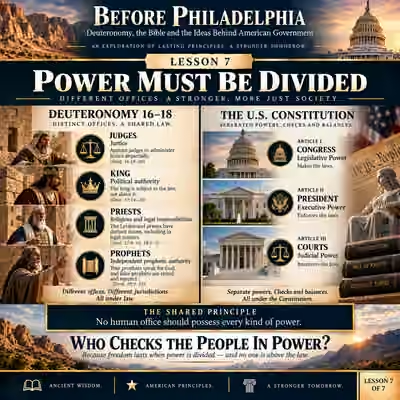
Imagine one person possesses every important governmental power.
He writes the law.
He enforces the law.
He decides what the law means.
He determines whether you violated it.
He decides whether his own actions violated it.
And if you are convicted, institutions controlled by him carry out the punishment.
There may still be laws.
There may still be courts.
There may even be official procedures.
But there is an obvious problem.
Who restrains the person controlling all of them?
The American constitutional answer is familiar.
Divide the power.
But America did not invent the broader idea that different kinds of authority should occupy different offices.
Deuteronomy had been wrestling with that problem thousands of years earlier.
And in chapters 16 through 18, something unusual happens.
The book stops looking merely like a collection of individual laws.
It begins to look like the architecture of a government.
Look at the offices
Read Deuteronomy 16:18 through 18:22 as a continuous section rather than as disconnected Bible passages.
First come the judges and officials.
Then a central process for difficult judicial cases.
Then the king.
Then the Levitical priests.
Then the prophets.
Each office possesses authority.
But none receives everything.
That distinction is the heart of this lesson.
The question is not whether ancient Israel possessed our legislative, executive and judicial branches.
It plainly did not.
The question is whether Deuteronomy deliberately distributes major public responsibilities among distinct institutions.
A significant body of scholarship argues that it does.
Bernard Levinson, a scholar of biblical law, describes Deuteronomy 16:18–18:22 as an early constitutional model in which important political powers are allocated to different institutions while all remain subordinate to the Torah that defines their jurisdiction.
Another scholarly treatment of the passage identifies the judiciary, monarchy, priesthood and prophetic office as distinct public institutions whose authority is defined by the governing text.
That deserves a closer look.
Start with the judges
We have already encountered the judicial system.
Deuteronomy instructs communities to appoint judges and officials.
Those judges are expected to administer justice impartially.
Difficult cases may be taken to a central authority.
Witness testimony is regulated.
False accusations are investigated.
Punishment follows adjudication.
Judicial power is therefore recognizable as its own function.
And something especially interesting happens when Deuteronomy turns to the king.
The judicial laws do not simply say:
If the judges cannot figure it out, ask the king.
The monarchy is treated separately.
Scholarship on the structure of these chapters has noted that Deuteronomy's king is conspicuously absent from the ordinary judicial structure described immediately before his office.
That matters because ancient kings commonly exercised judicial authority.
Deuteronomy's arrangement limits that concentration.
Then comes the king
Deuteronomy 17 permits monarchy.
But we have already seen what kind.
The king cannot multiply military resources for himself without limit.
He cannot accumulate wives without limit.
He cannot accumulate enormous quantities of silver and gold.
Most importantly, he must possess the law, read it and obey it.
He is warned not to elevate himself above his fellow Israelites.
So even the most visibly powerful political office is not presented as sovereign over the constitutional order.
The king does not create the standard that governs him.
The law does.
That gave us Lesson One:
The ruler is under the law.
Now we can see that the king's limitation also has a structural dimension.
He is one office among several.
Important?
Absolutely.
Unlimited?
No.
Then come the priests
Deuteronomy 18 gives the Levitical priests their own sphere.
Their office is primarily religious and cultic, but priests also appear in the central legal process described in Deuteronomy 17.
That mixture immediately tells us why we cannot equate them with any branch of modern American government.
The United States Constitution intentionally separates governmental authority from an established national priesthood.
Ancient Israel did not.
Religion and civil order were intertwined within the covenant.
Still, the priesthood represents another institution whose legitimacy and responsibilities do not simply derive from the king.
The king is not automatically the high priest.
Political authority and priestly authority are not simply merged into one office.
That is another distribution of power.
Then come the prophets
The prophetic office makes the structure even more unusual.
A prophet can confront kings.
A prophet can speak to the nation.
A prophet claims authority that does not depend upon appointment by the monarch.
That could become extraordinarily powerful.
So Deuteronomy regulates that office too.
Not everyone who says “God told me” is automatically granted unquestioned public authority.
Deuteronomy 18 establishes standards surrounding prophetic legitimacy and false prophecy.
Again, the specific institution is unlike anything in the United States Constitution.
There is no constitutional “prophetic branch.”
But the structural point remains interesting.
Even charismatic or religious authority exists within boundaries.
No office receives a blank check.
Put the four together
Now look at the complete picture.
Judiciary: Administers justice.
King: Exercises political and executive authority but remains under law.
Priesthood: Exercises cultic, teaching and some adjudicatory authority.
Prophetic office: Exercises an independent religious and moral authority, subject to standards governing its legitimacy.
This is not modern separation of powers.
But neither is it total concentration of authority in one ruler.
Levinson argues that this arrangement is significant precisely because Deuteronomy both divides jurisdiction and subordinates the institutions to the written Torah.
That second part may be as important as the first.
Power is divided.
And the law stands above the offices.
But was this actually Israel's government?
Here we need another historical caution.
A legal ideal and actual political practice are not always the same thing.
Levinson himself describes the Deuteronomic structure as a largely ideal or utopian constitutional model and argues that there is little evidence it was implemented exactly as designed.
Other scholarship similarly warns that Deuteronomy's judicial organization may reflect an ideological program rather than a precise description of everyday governmental reality in ancient Israel and Judah.
That distinction matters.
The United States Constitution is itself a governing document implemented through actual institutions.
Deuteronomy's political legislation also functions as theological and legal instruction within a covenant text.
So our claim should remain narrow.
We are examining the political idea articulated by the text.
Not claiming that ancient Israel operated like Washington, D.C.
It did not.
Now move forward several thousand years
The United States Constitution opens its governmental architecture with three articles.
The organization is immediately visible.
Article I vests legislative powers granted by the Constitution in Congress.
Article II vests executive power in the President.
Article III vests judicial power in one Supreme Court and such inferior federal courts as Congress establishes.
Legislative.
Executive.
Judicial.
Different institutions.
Different powers.
The organization is so familiar that Americans can forget how consequential the choice is.
Governmental power exists.
But nobody gets all of it.
Why not just elect one good person?
That question gets us closer to the philosophy underneath the Constitution.
If political problems could be solved simply by finding sufficiently virtuous rulers, institutional structure would matter much less.
Find a good king.
Give him authority.
Trust him.
The American Constitution operates on a different assumption.
Character matters.
But structure matters too.
Because even good people are human.
And offices outlast the people occupying them.
The question therefore cannot merely be:
Do we trust today's president?
Or:
Do we trust today's Congress?
Or:
Do we trust today's Supreme Court?
The constitutional question is:
What power should this office possess even when someone we do not trust occupies it?
That is a far more durable way to design government.
Montesquieu belongs in this story
This is where any attempt to claim that American separation of powers simply came from Deuteronomy would fall apart historically.
The immediate intellectual history is much better documented.
Baron de Montesquieu's *The Spirit of the Laws* was enormously important to eighteenth-century political thought.
Congress's own constitutional history specifically notes that Madison discussed Montesquieu when defending the Constitution's allocation of legislative, executive and judicial power.
Early American state constitutions had also already adopted versions of separation of powers before the federal Constitution was drafted.
So we should be explicit:
The American three-branch structure has direct historical sources much closer to Philadelphia than Deuteronomy.
That fact is not a problem for this series.
It is exactly the kind of distinction this series is supposed to make.
We're not looking for convenient ancestry.
We're looking for defensible ancestry.
Virginia had already written it down
The Virginia Constitution of 1776 declared that the legislative, executive and judicial departments should be separate and distinct.
Massachusetts made a similarly explicit division in its 1780 constitution, prohibiting each department from exercising the core powers belonging to the others.
And Massachusetts explained why:
So that the commonwealth would be a government of laws rather than men. Congress's constitutional history identifies both state constitutions as important examples of the separation-of-powers principle already operating in America before the federal Constitution.
That matters.
Philadelphia did not begin with a blank sheet of paper.
The states were already experimenting with constitutional government.
Some experiments worked better than others.
The federal Constitution emerged partly from those experiences.
Madison addresses the objection
When critics attacked the proposed Constitution, one complaint was that it did not separate powers strictly enough.
James Madison responded in *Federalist No. 47*.
He acknowledged the importance of keeping legislative, executive and judicial power distinct.
He also addressed Montesquieu directly and examined how actual constitutions distributed those powers.
Madison's point was not that branches could never interact.
It was that the entire power of one department should not be concentrated in the same hands as the entire power of another.
That distinction is essential.
The United States does not practice absolute separation of powers.
Its branches overlap deliberately.
Which brings us to the next idea.
Separation is not enough
Suppose we create three boxes.
Congress.
President.
Courts.
Then we tell each:
Stay in your box.
Would that solve the problem?
Madison did not think so.
Paper boundaries could be ignored.
One branch might slowly accumulate the power of another.
So *Federalist No. 51* asks how the constitutional system can preserve the division of authority in practice.
The answer is structural.
The internal design of government must allow its different parts to help keep one another within their proper places.
That is the logic of checks and balances.
The branches are divided—and connected
Consider a few examples.
Congress passes legislation.
But the president may veto it.
Then Congress may override the veto with sufficient votes.
The president nominates federal judges.
But the Senate participates in confirming them.
The president negotiates treaties.
But the Senate must provide constitutionally required consent.
Congress controls appropriations.
The president commands the armed forces.
The House can impeach.
The Senate conducts impeachment trials.
The judiciary independently decides cases and controversies under the Constitution and federal law.
This is not three sealed rooms.
It is a system of separated powers with intentional points of friction.
Congress's constitutional history describes exactly that design: the Framers separated the branches while simultaneously creating mechanisms through which each could check another.
The friction is not necessarily a design failure.
Sometimes the friction is the design.
Why make government inefficient?
This can frustrate people.
A president wants something done.
Congress refuses.
Congress passes something.
The president vetoes it.
The Senate blocks an appointment.
A court strikes down governmental action.
Why make governing so difficult?
Because speed is not the only value in constitutional government.
So is restraint.
A government that can do everything immediately can also do terrible things immediately.
The American structure accepts some inefficiency as the price of making concentrated power harder to obtain.
That does not mean gridlock is always healthy.
It means the system was not designed around the assumption that governmental efficiency is the highest political good.
Liberty sometimes requires friction.
Now return to Deuteronomy
Deuteronomy does not give us Madisonian checks and balances.
There is no presidential veto.
No congressional override.
No Senate confirmation.
No impeachment trial structured like ours.
No judicial review in the modern American sense.
We should not place concepts in the ancient text that are not there.
But we can still ask:
What prevents every form of public authority from simply collapsing into the king?
The answer is partly institutional.
The judges have authority.
The priests have authority.
The prophet possesses authority.
The king has authority.
And the law defines them.
According to Levinson's reading, that division of public jurisdiction is one of the features that makes Deuteronomy unusually significant in the history of constitutional thought.
That is a much more defensible claim than saying:
“Moses invented the three branches of government.”
He didn't.
We do not need him to have done so for the comparison to matter.
Two different kinds of separation
I think the distinction can be stated simply.
Deuteronomy gives us something resembling differentiated offices and jurisdictions.
The United States Constitution gives us separated governmental powers plus checks and balances.
Those are related ideas.
They are not identical ideas.
And the second represents a far more elaborate institutional architecture.
That is historical development.
One generation does not have to reproduce another generation's institutions for an underlying political insight to survive.
The deeper insight is distrust of concentrated power
That brings us back to the beginning.
What happens when one person controls everything?
If the king controls the courts, priesthood, prophetic voice, law and administration, political authority becomes extraordinarily difficult to restrain.
If the American president could legislate without Congress, prosecute under those laws, adjudicate the resulting cases and determine constitutional limits for himself, calling him “president” instead of “king” would not solve much.
Titles do not restrain power.
Structure does.
That is the insight behind separation of powers.
But law must stand over the structure too
There is another connection to Lesson One.
Dividing power alone is not enough.
Imagine three branches, each unlimited inside its own domain.
That still creates serious danger.
The American branches therefore operate under a Constitution that defines their authority.
Congress receives legislative powers granted by Article I.
The president receives executive authority under Article II.
The judiciary receives judicial authority under Article III.
The institutions are not sovereign.
The Constitution is superior to the officers occupying them.
Deuteronomy does something structurally comparable at a much earlier stage.
Its public offices are established and then bounded by a legal text.
The king is perhaps the clearest example because he is explicitly commanded to study and obey the law rather than elevate himself above it.
Power divided.
Power bounded.
Those two ideas work together.
Now look back at all seven lessons
This is where the series begins to form a picture.
Lesson One: The Ruler Is Under the Law
Political office does not place the ruler above the governing standard.
Lesson Two: Justice Cannot Have a Favorite
Judicial authority must operate impartially rather than according to wealth, bribery or status.
Lesson Three: Evidence Before Conviction
An accusation is not enough. Government must establish its case through evidence.
Lesson Four: Guilt Is Personal
The offender's guilt does not become hereditary guilt.
Lesson Five: Punishment Has Limits
Government's legitimate power to punish is not unlimited.
Lesson Six: Authority Stops at the Door
Even a lawful claim does not erase every boundary surrounding a person's home.
Lesson Seven: Power Must Be Divided
Public authority is distributed rather than concentrated entirely in one office.
Now ask yourself:
Are those merely seven unrelated regulations?
Or do they reveal something larger about the political philosophy running through Deuteronomy?
I think the second possibility deserves serious consideration.
The pattern is restraint
Look at the direction in which almost every rule moves.
It does not eliminate authority.
It limits authority.
Deuteronomy has rulers.
Judges.
Punishment.
Debt.
Military power.
Priests.
Prophets.
Government is not weak.
But authority repeatedly encounters a boundary.
You may govern.
But obey the law.
You may judge.
But do not favor people.
You may convict.
But establish the evidence.
You may punish.
But punish the responsible person.
You may punish the responsible person.
But do not degrade him without limit.
You may collect what is owed.
But do not simply invade the home.
You may hold public authority.
But you do not hold every kind of authority.
That is not libertarianism.
It is not modern liberalism.
It is not the American Constitution.
It is ancient covenant law.
But it contains a recognizable suspicion of unbounded human power.
And that is constitutionally significant.
The Founders had additional reasons to distrust concentrated authority
American political thought did not arrive at this point through Scripture alone.
The Founders had English history.
They had monarchy.
They had Parliament.
They had colonial governors.
They had general warrants.
They had state constitutional experiments.
They had classical history.
They had Locke.
They had Montesquieu.
They had Blackstone.
They had centuries of Christian political thought.
And they had the Bible.
Those streams interacted.
Any honest account of American constitutionalism has to leave room for all of them.
That is why this series has deliberately resisted saying:
“The Constitution came from Deuteronomy.”
That is not the argument.
The better argument is more interesting.
Ideas have histories longer than documents
The Constitution was written in 1787.
That does not mean the ideas appearing inside it were born in 1787.
Separation of powers had a pre-Philadelphia history.
Rule of law had a pre-Philadelphia history.
Limits on punishment had a pre-Philadelphia history.
Procedural safeguards had a pre-Philadelphia history.
Protections surrounding the home had a pre-Philadelphia history.
Individual responsibility had a pre-Philadelphia history.
Some of those histories run through England.
Some through Enlightenment political thought.
Some through classical antiquity.
Some through Christian political theology.
And some reach much farther back into biblical law.
The interesting historical question is not:
Which single book created America?
No serious historian should answer that question with one book.
The interesting question is:
What intellectual traditions supplied the ideas Americans eventually assembled into their constitutional system?
Deuteronomy belongs somewhere in that investigation.
How large a place it deserves is the question we have been building toward from the beginning.
The principle beneath both systems
If I had to reduce Lesson Seven to one sentence, it would be this:
# No human office should possess every kind of power.
Deuteronomy distributes authority among multiple institutions and subjects them to law.
The American Constitution separates legislative, executive and judicial powers and then creates checks through which those institutions restrain one another.
The systems are not the same.
Their offices are not equivalent.
Their sources of authority are not identical.
Their constitutional mechanics are dramatically different.
But both recognize a danger that has never disappeared:
Human beings become more dangerous when power becomes difficult to challenge.
The American answer is institutional competition.
Congress.
President.
Courts.
Federalism.
Elections.
Impeachment.
Judicial independence.
Checks and balances.
Deuteronomy's answer is much older and less elaborate.
Different offices.
Different jurisdictions.
One law standing over them.
Different architecture.
A recognizable warning.
# Power must be divided.
Now we can answer the question
Seven lessons ago, I deliberately refused to begin this series with a percentage.
I had an estimate.
But starting there would have turned the exercise into an argument over a number before we looked at the evidence.
So we started with the evidence instead.
We have now examined:
Rule of law.
Judicial impartiality.
Evidentiary safeguards.
Individual criminal responsibility.
Limits on punishment.
Boundaries surrounding the home.
And divided governmental authority.
We have also identified where the comparisons stop.
English common law matters.
The English Bill of Rights matters.
Colonial experience matters.
State constitutions matter.
Locke matters.
Montesquieu matters.
Blackstone matters.
Classical republicanism matters.
And biblical political thought matters.
Now we are ready for the question that started this entire project:
How much?
How much of America's founding political thought can reasonably be connected to Deuteronomy?
How much can be connected to the Bible more broadly?
What does the historical citation evidence actually show?
What does it not show?
And when someone says either:
“America was founded entirely on the Bible”
or
“The Bible had essentially nothing to do with the American founding,”
does the historical record really support either claim?
That is where *Before Philadelphia* ends.
Not with another parallel.
With an accounting of the evidence.
Closing installment:
# BEFORE PHILADELPHIA: SO HOW MUCH OF AMERICA'S FOUNDING WAS BIBLICAL?
We have spent seven lessons gathering the pieces.
Next, we put them on the table.
And then the judgment belongs to the reader.
---
Primary texts and further reading
Deuteronomy 16:18–18:22 contains the governmental material at the center of this lesson: judges and officials, central adjudication, kingship, priestly authority and prophecy. Bernard Levinson has argued that this section represents an early model of divided public authority operating beneath a governing legal text.
Deuteronomy 17:14–20 is particularly important because the king is subjected to written law and restricted in the accumulation of military resources, wealth and personal power.
Articles I, II and III of the United States Constitution vest legislative power in Congress, executive power in the president and judicial power in the federal courts.
The Constitution Annotated history of separation of powers explains the Framers' reliance on a three-branch structure, the influence of Montesquieu and prior state constitutions, and the Constitution's additional system of checks and balances.
Federalist No. 47 contains Madison's defense of separating legislative, executive and judicial power and his discussion of Montesquieu.
Federalist No. 51 explains why written boundaries alone were insufficient and why the internal structure of government needed to enable its constituent parts to keep one another within their proper constitutional roles.